You track inventory religiously. Your team updates spreadsheets daily. You know exactly what's in the warehouse - or so you think. Yet customers still hear "out of stock" when they order your best-selling items, while slow-moving products consume valuable shelf space and working capital. This is the inventory paradox facing growing SMEs: having data without control. The problem isn't visibility - it's that tracking what happened yesterday doesn't prevent tomorrow's stockout. Real inventory control means systems that make decisions, not just record transactions. Here's why inventory breaks as businesses scale, and what actual control looks like beyond spreadsheets and static rules.
Key Takeaways
Why do stockouts happen even when tracking inventory?
Stockouts occur despite tracking because stockouts account for 40% of lost sales, driven by lag between physical and system updates, reliance on outdated static rules, supplier lead time variability, and failure to differentiate fast-movers from slow-movers in reorder logic.
What are the limits of min–max inventory for growing SMEs?
Min-max assumes constant demand and fails when business scales because it doesn't account for seasonality, SKU-level differences, supplier variability, or demand fluctuations - triggering reorders even for dying products and creating excess inventory.
How do supplier lead times create hidden inventory risk?
72% of SMEs experience unpredictable delivery times from suppliers, making fixed reorder points obsolete. Variable lead times cause emergency purchases, stockouts during demand spikes, and overstocking when delays resolve unexpectedly.
When does Excel stop working for inventory management?
Excel breaks when scaling past 15-20 employees, managing 200+ SKUs, handling multiple warehouses, requiring real-time updates across departments, or when version conflicts cause "too many truths" costing 15-20 hours weekly in reconciliation.
What does scalable inventory control actually look like?
Real control means SKU-level reorder rules adapting to demand patterns, automated decision triggers replacing manual monitoring, exception alerts instead of constant supervision, supplier performance tracking influencing reorder timing, and multi-location visibility with approval workflows.
Can stockouts be prevented without overstocking?
Yes - through demand-based reordering using historical patterns, safety stock calculated per SKU variability, supplier lead time buffers, seasonal adjustments, and automated alerts triggering at optimal reorder points rather than arbitrary min-max thresholds.
Why Does Inventory Break as SMEs Start Scaling?
Inventory management works beautifully when you're small. Ten products, one warehouse, a single person who knows every item's status - simple. But growth changes everything, and the informal systems that worked at 10 employees catastrophically fail at 30.
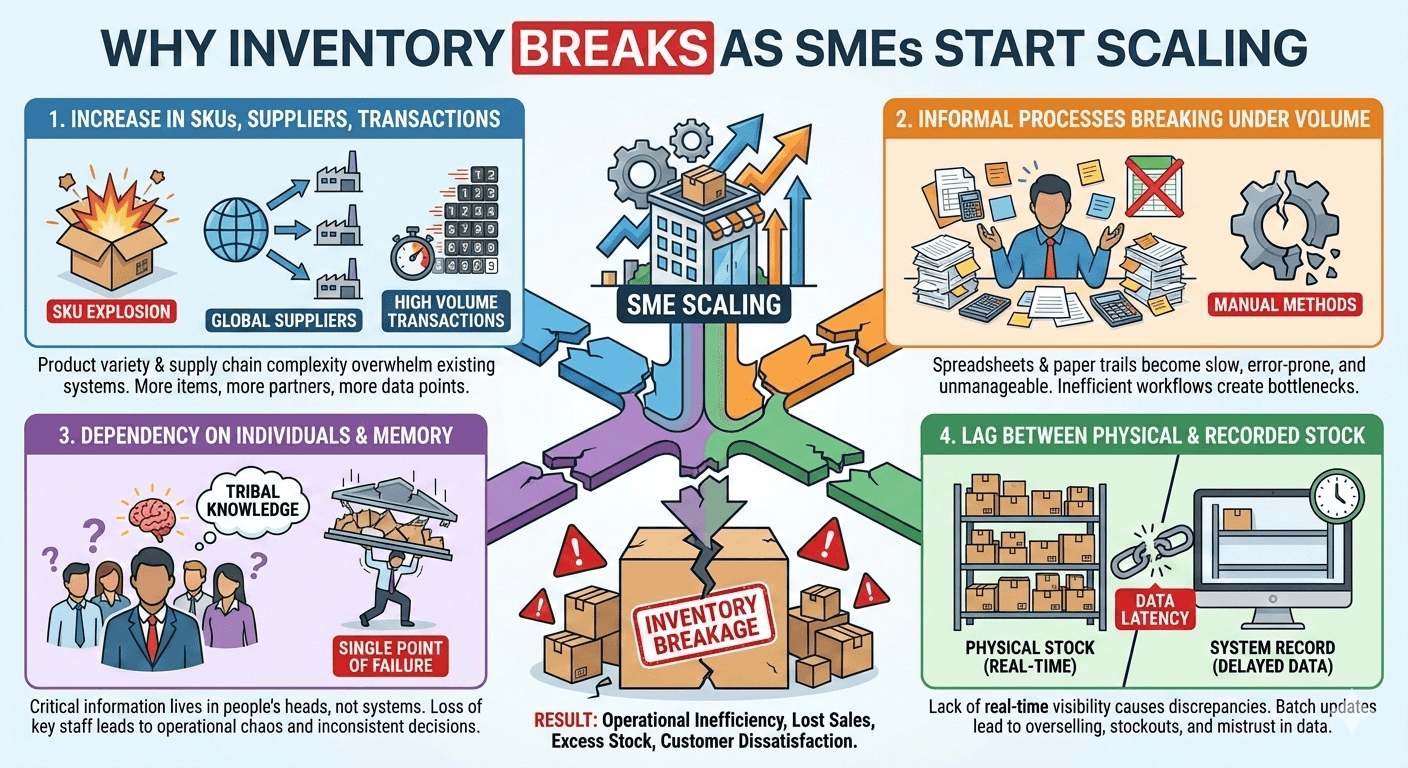
SKU explosion creates complexity
You started with 15 core products. Two years later, you're managing 150 SKUs across multiple product lines. Each SKU has different:
- Demand patterns (daily vs weekly vs seasonal)
- Supplier lead times (3 days vs 6 weeks)
- Shelf life or obsolescence risk
- Margin impact (losing a ₹500 item hurts differently than ₹5,000)
- Storage requirements (bulky vs compact, refrigerated vs ambient)
Excel formulas designed for 15 items don't scale to 150. The mental model of "check stock every Monday" becomes impossible when Monday means reviewing 150 reorder decisions.
Volume overwhelms informal processes
At 50 orders monthly, memory works. "We usually need 100 units of X." At 500 orders monthly, memory fails. What "usually" means becomes statistically meaningless as variability increases.
Transaction volume compounds:
- sales orders monthly
- purchase orders
- goods received notes (GRNs)
- stock transfers between locations
- Daily adjustments for returns, damage, pilferage
Informal coordination ("I'll tell Ramesh to reorder that") breaks when Ramesh is on leave, or when 20 items need reordering simultaneously, or when nobody remembers who owns which decision.
Dependency on individuals becomes operational risk
"Only Priya knows the reorder schedule" sounds manageable - until Priya leaves or gets promoted. Tribal knowledge walking out the door means:
- New hires taking weeks to learn undocumented rules
- Inconsistent decisions ("I thought we always kept 200 units?")
- Panic when key person unavailable during critical reorder decision
- No institutional learning - mistakes repeated because nothing's systematically tracked
Only 26% of companies currently have a proactive supply chain network, meaning 74% remain reactive - firefighting stockouts instead of preventing them.
Lag between physical and recorded stock grows dangerous
Small operations reconcile physical vs system stock weekly or even daily. As scale increases, reconciliation frequency drops while discrepancy sources multiply:
- Items sold but not invoiced yet
- Goods received but not logged in system
- Damaged stock not adjusted
- Returns processed physically but not recorded
- Theft or shrinkage discovered only during annual counts
The average U.S. retail business has an inventory accuracy of only 66%. In growing SMEs without systematic processes, accuracy often drops below 60% - meaning reorder decisions based on "system says 100 units" when physical count shows 60 create guaranteed stockouts.
What Are the Most Common Inventory Problems Faced by SMEs?
Let's diagnose the specific failures causing inventory pain. If you recognize three or more of these scenarios, your inventory isn't under control - it's under constant crisis management.
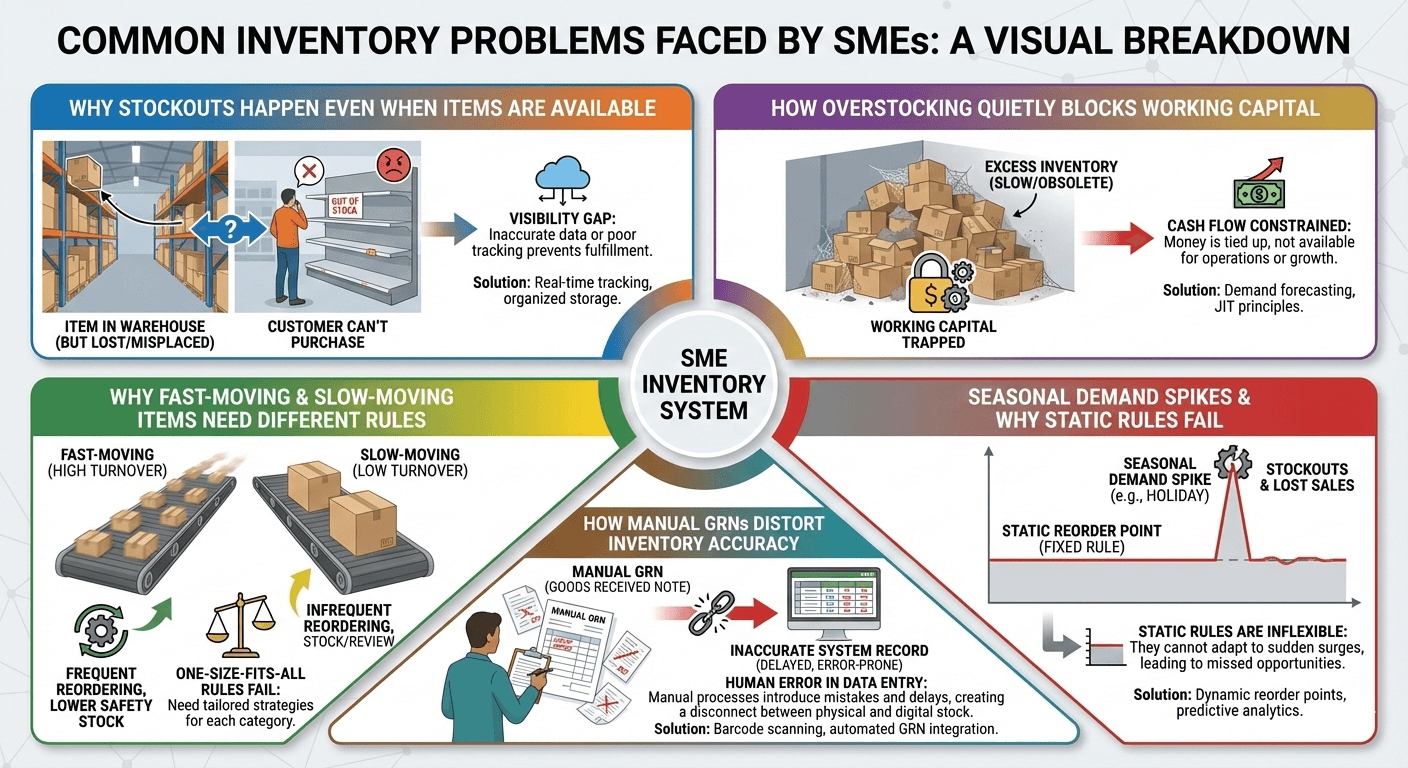
Why do stockouts happen even when items are available?
The cruelest inventory failure: product sits in your warehouse while customers hear "out of stock."
Location invisibility
Multi-location businesses often can't answer "where exactly is Item X?" Warehouse A shows 50 units, Warehouse B shows 30, but sales team can't confirm which location can fulfill today's order. Customer waits 2 days for inter-branch transfer when nearby warehouse had stock - or worse, order rejected as "unavailable" while 80 units sit unused.
Allocation confusion
You have 100 units in stock, but:
- allocated to pending Customer A order (not yet shipped)
- reserved for production batch starting Monday
- damaged, awaiting quality review
- Available for new orders: 10 units
System shows "100 in stock" - sales promises delivery to Customer B for 50 units, triggering stockout when allocation reality hits. Without tracking allocated vs available inventory, every reorder decision uses wrong data.
Quality hold limbo
Manufacturing SMEs face this constantly: Batch received from supplier, quantity logged into system, but quality check pending. System says "in stock," but items can't ship. By the time quality approval happens (3 days later), sales already promised delivery based on false availability.
How overstocking quietly blocks working capital
Too much inventory limits a company's capital and ability to invest - yet overstocking feels safe compared to stockouts, creating hidden costs that silently kill profitability.
Cash tied up in slow-movers
₹12L sitting in slow-moving inventory could be:
- Down payment on new equipment
- Marketing budget for customer acquisition
- Working capital for faster-moving SKUs
But it's sitting on shelves because min-max rules don't adapt when products slow down. System says "reorder when below 200 units," so you keep reordering even though sales dropped from 50/month to 5/month.
Obsolescence and expiry risk
Products with shelf life or rapid obsolescence carry dual costs:
- Initial purchase price
- Write-off when expired/obsolete
Food, pharmaceutical, electronics, fashion businesses particularly vulnerable. Overstocking a seasonal item in March means discounting 40% in May, then writing off remaining stock in June - triple financial hit from one bad reorder decision.
Warehousing cost multiplication
Every ₹1L of excess inventory costs approximately:
- ₹15K-20K annually in warehousing (space, utilities, insurance)
- ₹5K-10K in handling labor
- ₹2K-5K in shrinkage/damage risk
Addressing the issues of overstocking and understocking can help businesses achieve a significant 10% reduction in inventory costs.
Why fast-moving and slow-moving items need different rules
Treating all SKUs the same is the fastest path to either stockouts (fast-movers) or excess (slow-movers).
Fast-movers starve under generic min-max
Item sells 200 units weekly with 7-day lead time. Min set at 300, max at 500. By Thursday (100 units sold), you're below min and reorder 200 units. But Friday-Monday sells another 100 units before supplier ships - now you're at 100 units with 6 days until arrival.
Stockout on Tuesday despite "following the rules" because generic min-max doesn't account for consumption rate during lead time.
Slow-movers accumulate excess
Item sells 5 units monthly with same 7-day lead time. Min set at 50 (copying fast-mover logic), max at 100. At 5/month consumption, this is 10-20 months of stock - ₹2L tied up in one slow SKU when ₹20K would suffice.
Business impact of wrong grouping
ABC classification helps but crude three-bucket approach misses nuance:
- A-items: High value, variable demand patterns
- B-items: Medium value, moderate demand
- C-items: Low value but critical availability (bolts for manufacturing might be ₹500 total value but missing them stops ₹5L production)
Seasonal demand spikes and why static rules fail
Manufacturers anticipate inventories shrinking by 1.6% in the coming 12 months as they correct post-pandemic overstocking, but seasonal businesses face opposite challenge - static rules cause massive under-preparation for known peaks.
Festival/holiday demand multiplication
Diwali sales might be 3-4x normal monthly volume. Min-max set for average demand means:
- October: Comfortably stocked
- Week before Diwali: Emergency purchases at premium prices
- Post-Diwali: Excess clearance
Static rules can't handle predictable seasonality. The answer isn't higher year-round min levels (creates excess 10 months/year) but dynamic adjustment based on calendar.
Weather-driven patterns
Cooling equipment, monsoon products, winter apparel - demand predictably spikes then crashes. Yet many SMEs discover they're understocked only after season starts, then overstocked when it ends.
B2B ordering cycles
Institutional buyers often place quarterly or year-end bulk orders. If 40% of annual volume comes in March-end, but min-max based on monthly average, guaranteed February stockout ruins entire quarter's relationship.
How manual GRNs distort inventory accuracy
The goods received note (GRN) process is where system-physical gaps originate - and compound into inventory chaos.
Delayed GRN entry
Physical scenario:
- Monday 10 AM: 500 units arrive, warehouse staff unloads
- Monday 4 PM: Quality check passes
- Tuesday 11 AM: Accounts department enters GRN into system
Meanwhile Monday afternoon: Sales checks system (shows old stock level minus yesterday's sales), tells customer "we're out of stock," rejects order. 500 units physically available but systemically invisible.
Quantity mismatches
Supplier ships 480 units vs invoice quantity of 500. Staff enters 500 (matching invoice), physical reality is 480. System over-reports by 20 units permanently (until next physical count discovers discrepancy months later). Every reorder decision using "500 received" data is wrong.
Batch/lot tracking failure
Manufacturing compliance often requires batch traceability. Manual GRN without batch capture means:
- Cannot track which units came from which supplier lot
- Quality issues discovered later can't be traced to affected batch
- Recall situations become "recall everything" instead of targeted removal
Inventory accuracy in U.S. retail operations is 63%, with manual GRN processes being primary contributor to that 37% error rate.
Is Min–Max Inventory Still Relevant for SMEs?
Min-max isn't inherently bad - it's context-dependent. Understanding when it works and when it catastrophically fails helps you decide if upgrading is urgent or optional.
When does min–max inventory actually work?
Stable, predictable demand environments
Consumables with consistent usage:
- Office supplies in established companies
- Standard spare parts with steady replacement cycles
- Commodity items with minimal demand fluctuation
If weekly demand varies by <20% and lead times are reliable, min-max provides adequate control without sophisticated forecasting.
Low SKU count businesses
Managing 20-30 SKUs allows manual review and adjustment of min-max levels quarterly. Human judgment compensates for formula limitations when scope is small.
Simple supply chains
Single warehouse, limited suppliers, no complex allocations or quality holds. When "total stock" genuinely means "available stock," min-max triggers work reliably.
When does min–max logic start failing?
Demand variability exposes static assumptions
Min-max assumes demand is constant and delivery is instant. Reality:
- A significant drawback of this model is that it assumes that demand is steady and constant
- Seasonal businesses see demand swing 300-400%
- Product lifecycle stages dramatically change consumption rates
- Market disruptions (competitor stockout, viral social media) spike demand unpredictably
Static min-max can't adapt - it reorders same quantity whether demand just doubled or halved.
Lead time variability creates safety stock confusion
Lead times in North America started 2023 with a steep half-year drop of 14%, before leveling out and even ticking back up a slight 1% by 2024. Supplier performance fluctuates, but min-max assumes fixed lead time.
Result: Min level calculated for "7-day lead time" causes stockout when supplier takes 12 days. Adjusting min upward for worst-case lead time creates permanent excess when supplier returns to 7-day performance.
SKU proliferation dilutes management attention
Most companies save no money in purchasing as a result of ordering less frequently. Min-max's "order less frequently" economic order quantity logic worked when managing 20 SKUs—operations manager reviewed levels monthly.
At 200 SKUs, monthly manual review becomes impossible. Min-max runs on autopilot with stale parameters, triggering reorders for dying products while understocking fast-growers.
Ignores interconnected constraints
Real business constraints min-max doesn't consider:
- Supplier minimum order quantities
- Warehouse capacity limits
- Budget constraints (can't order 10 items simultaneously)
- Cross-selling dependencies (Item A always sells with Item B)
- Promotional cycles
You might have minimum order quantities from your suppliers. These reflect the fact that every time you pass a reorder, the supplier has to make a delivery.
How demand-based reordering differs from static min–max rules
Actual consumption drives decisions
Instead of "reorder when below 200 units," demand-based logic says "reorder when remaining stock won't last through next delivery cycle."
Calculation:
- Current stock: 250 units
- Average daily consumption (last 30 days): 25 units
- Supplier lead time: 7 days
- Days of stock remaining: 250 ÷ 25 = 10 days
Verdict: Reorder now (10 days stock < 7 day lead time + safety buffer means risk).
If consumption drops to 15 units daily:
- Days of stock: 250 ÷ 15 = 16.7 days
- Verdict: Don't reorder yet
Same inventory level, different decision based on current consumption pattern.
Safety stock becomes dynamic
Static approach: "Keep 100 units safety stock always."
Demand-based approach: Safety stock = (Maximum daily usage - Average daily usage) × Lead time
If demand variability increases (standard deviation rises), safety stock automatically adjusts. If supplier reliability improves (lead time variance drops), safety stock can reduce without increasing stockout risk.
Seasonal patterns get incorporated
System recognizes "November-December consumption averages 3x rest of year" and adjusts reorder triggers accordingly. October reorders factor in upcoming spike, January reorders recognize returning to baseline.
How Supplier Lead Time Creates Hidden Inventory Risk
72% of SMEs are experiencing unpredictable delivery times from suppliers, yet most inventory planning treats lead time as a constant. This mismatch between assumption and reality creates cascading failures.
Fixed vs variable lead times
Fixed lead time assumption:
- Supplier promises 7 days
- System calculates reorder point assuming 7 days
- Safety stock sized for 7-day window
Variable lead time reality:
- Sometimes 5 days (raw material available)
- Sometimes 12 days (supplier's supplier delayed)
- Once 25 days (customs clearance issue)
- Average: 8.5 days, Standard deviation: ±5 days
Planning for average means 50% of deliveries arrive late. Planning for worst-case means permanent 30-40% excess inventory.
Impact of delays on reorder points
Reorder point formula: (Average daily usage × Lead time) + Safety stock
If daily usage = 20 units, lead time = 7 days, safety stock = 50:
Reorder point = (20 × 7) + 50 = 190 units
When lead time jumps to 12 days unexpectedly:
Stock required = (20 × 12) + 50 = 290 units
You reordered at 190, expecting 7-day delivery. Day 8-12 consumes another 100 units. Stock hits zero on day 11—day before delivery arrives.
Emergency purchases caused by poor planning
Emergency purchases cost 20-40% premium:
- Expedited shipping fees
- Premium pricing from alternative suppliers
- Production downtime if materials critical
- Opportunity cost of urgent firefighting vs strategic work
SME paying ₹10L annually on inventory might waste ₹1.5-2L on emergency purchases caused by supplier lead time variability that better planning would absorb.
Lead time tracking reveals supplier performance patterns
Most SMEs don't systematically track:
- Promised vs actual delivery dates
- Variance patterns by supplier
- Seasonal degradation (monsoon delays, holiday backlogs)
Without data, every stockout feels like unpredictable bad luck. With tracking, patterns emerge: "Supplier X reliably delays 3-4 days during month-end" becomes plannable.
Why SKU-Level Reorder Rules Matter More Than Global Rules
"One size fits all" inventory rules guarantee waste and stockouts simultaneously - just in different products.
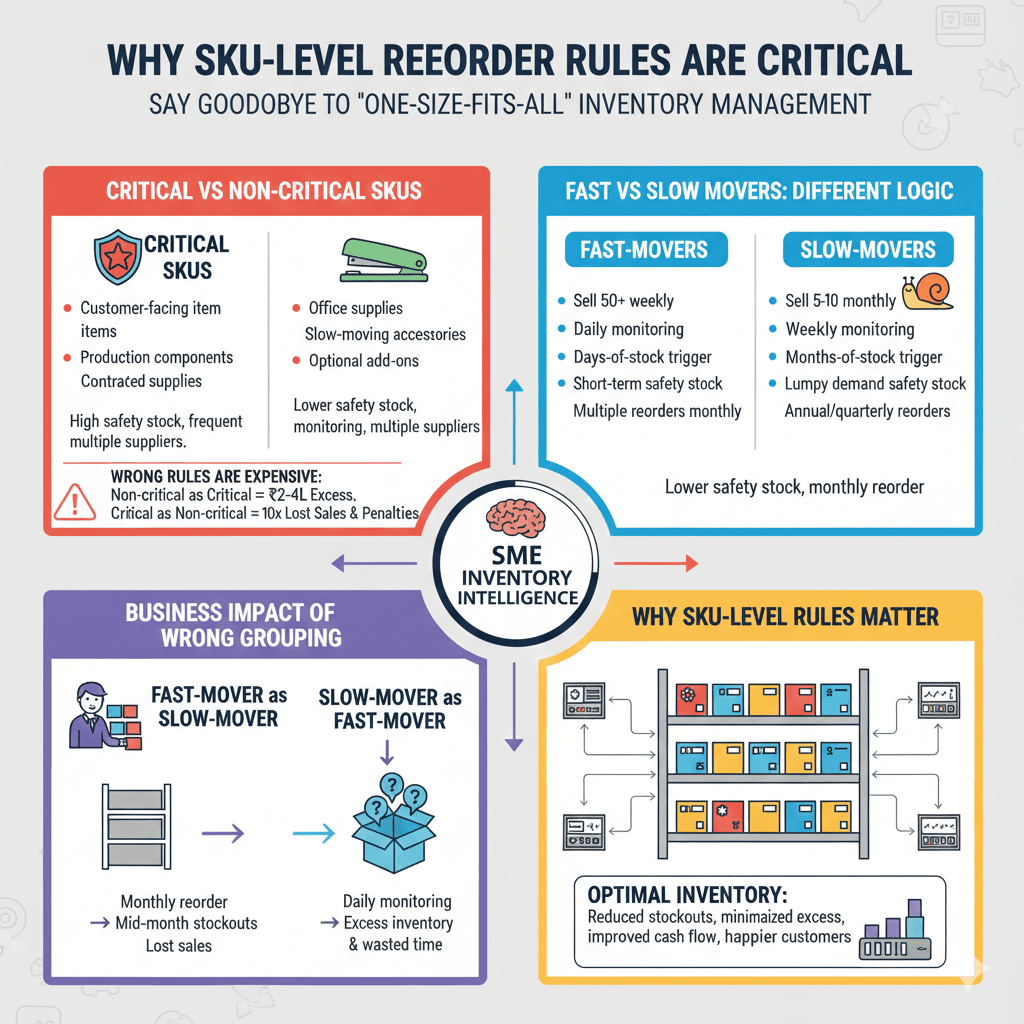
Critical vs non-critical SKUs
Critical SKUs (stockout causes severe business impact):
- Customer-facing items driving revenue
- Components blocking production if unavailable
- Contract-committed supplies with penalty clauses
Deserves higher safety stock, more frequent monitoring, multiple supplier options.
Non-critical SKUs (stockout causes inconvenience, not crisis):
- Office supplies
- Slow-moving accessories
- Optional add-ons
Can tolerate occasional stockout, lower safety stock acceptable, reorder monthly vs weekly.
Applying critical-SKU rules to non-critical items wastes ₹2-4L in excess inventory. Applying non-critical rules to critical items costs 10x that in lost sales and penalties.
Fast vs slow movers demand different logic
Fast-movers (sell 50+ units weekly):
- Need daily or real-time monitoring
- Reorder triggers based on days-of-stock calculation
- Safety stock calculated from short-term demand variance
- Multiple reorders monthly normal
Slow-movers (sell 5-10 units monthly):
- Weekly monitoring sufficient
- Reorder triggers based on months-of-stock
- Safety stock sized for lumpy, unpredictable orders
- Annual or quarterly reorders normal
Business impact of wrong grouping
Treating fast-mover like slow-mover:
- Reorder once monthly regardless of consumption
- Result: Stockouts mid-month, customer frustration, lost sales
Treating slow-mover like fast-mover:
- Monitor daily, panic when stock dips slightly
- Result: Over-ordering, excess inventory, wasted management attention
What Happens When You Add Multiple Warehouses or Locations?
Single-warehouse inventory is hard. Multi-warehouse inventory is exponentially harder - complexity doesn't add, it multiplies.
Visibility gaps across locations
Question: "Do we have Item X in stock?"
Answer depends on: Which location? Available or allocated? Including in-transit between locations?
Without unified visibility:
- Location A refuses customer order ("We're out") while Location B has excess
- Inter-branch transfer takes 3 days but customer quotes 2-week lead time
- Sales team calls each warehouse individually - accurate answer takes 30 minutes
Inter-branch transfers create inventory limbo
Item transferred from Warehouse A to B:
- Tuesday: Shipped from A (removed from A's stock count)
- Wednesday-Thursday: In transit
- Friday: Received at B
Where is stock Tuesday-Thursday? Nowhere, systemically. Both locations show reduced inventory, total company stock appears lower than reality. Reorder triggers during transit create excess when transfer completes.
Approval and accountability issues
Multi-location businesses face:
- Who authorizes inter-branch transfers?
- Who owns cost when transfer needed due to poor planning?
- How to prevent one location hoarding stock?
- Who decides which location gets limited stock during shortage?
Without clear rules and workflows:
- Transfer requests delayed ("I need manager approval")
- Political conflicts ("Why does their location always get priority?")
- Inefficient stock distribution (one location 150% stocked, another at 40%)
As of 2024, 9% of businesses achieve full visibility, but 63% still struggle with limited visibility across their supply chain.
Batch & Serial Number Tracking - When Does It Become Necessary?
Not every business needs batch-level tracking - but for those that do, absence creates compliance disasters and quality nightmares.
Compliance and traceability needs
Mandatory batch tracking industries:
- Food & Beverage: Track ingredients and batches for recall capability
- Pharmaceuticals: Regulatory requirement for drug lot tracking
- Medical devices: Patient safety demands traceability
- Automotive parts: Warranty and recall management
Industries where batch tracking prevents business risk:
- Electronics: Component lot tracking for quality issues
- Chemicals: Batch testing and certification
- Cosmetics: Expiry and formulation batch management
Risks of ignoring batch-level control
Scenario: Quality issue discovered in finished product. Which raw material batch caused it?
Without batch tracking:
- Cannot identify affected products (must recall everything)
- Cannot trace to supplier lot (can't claim compensation)
- Cannot prevent using remaining defective inputs
Real cost example: ₹15L worth of finished goods recalled because ₹50K defective input batch couldn't be isolated - entire month's production discarded.
Serial number tracking for high-value items
Warranted when:
- Individual units tracked through customer lifecycle
- Service/maintenance tied to specific serial numbers
- Theft prevention or asset management critical
- Regulatory compliance requires device-level traceability
Tracking overhead only justified for high-value items (electronics, machinery, medical devices) or compliance-mandated scenarios.
Why Inventory Accuracy Depends on Process, Not Just Software
Best inventory software won't fix broken processes - garbage in, garbage out.
Manual GRNs create persistent errors
Root causes of GRN-driven inaccuracy:
- Timing lag: Physical receipt happens hours/days before system entry
- Transcription errors: Handwritten notes misread when entering
- Quantity verification gaps: Driver says "5 boxes," each box supposed to contain 20 units - did anyone verify?
- Partial deliveries: 3 of 5 boxes arrived, but GRN entered as "complete"
Each error compounds. After 100 GRNs with 5% error rate, system accuracy drops to 60-70% without physical count corrections.
Adjustments, shrinkage, pilferage
Inventory decreases without corresponding sales:
- Damage: Dropped in warehouse, customer return unusable
- Sampling: Units given to prospects for testing
- Internal use: Office consumed items meant for sale
- Theft: External (shoplifting) or internal
If adjustments not logged immediately and accurately, system shows phantom stock. Reorder decisions based on inflated numbers guarantee stockouts.
Audit challenges without process discipline
Annual physical count finds 15% variance between system and actual. But which is right?
- System could be wrong (entry errors accumulated)
- Physical count could be wrong (counting mistakes, deliberate fudging)
- Both could be partially wrong
Without audit trails showing who did what when, impossible to diagnose root cause. Next year, same 15% variance reappears.
What Does "Inventory Control" Actually Look Like for SMEs?
Control isn't tracking - it's the system making decisions based on rules you've defined, not humans manually deciding each action.
Rule-based decisions replace constant monitoring
Manual approach:
- Operations manager checks 150 SKU levels daily
- Decides which to reorder based on experience
- Emails purchase team with list
- Purchase team verifies budget, places orders
Rule-based approach:
- System calculates daily: (Current stock ÷ Daily usage) = Days remaining
- Auto-generates reorder list when Days remaining < (Lead time + Buffer)
- Routes to appropriate approver based on value thresholds
- Tracks until order placed and delivery received
Manager reviews exceptions ("Why is this flagged?") rather than making 150 daily decisions.
Exception handling becomes the work
Control systems surface anomalies requiring human judgment:
- "Consumption spiked 300% this week - confirm reorder or investigate reason?"
- "Supplier lead time increased from 7 to 14 days - adjust reorder points?"
- "Stock aging: 40% of X hasn't moved in 90 days - reduce reorder quantity?"
Humans handle judgment calls. System handles math, monitoring, and routine triggers.
Reduced dependency on individuals
Knowledge lives in documented rules, not people's heads:
- Reorder logic: "If Days-of-stock < Lead-days + Safety-buffer, trigger reorder"
- Approval workflow: "Value < ₹50K: Ops approval. Value > ₹50K: Finance + Ops approval"
- Supplier selection: "Primary supplier if lead time < 7 days, Secondary if > 7 days"
New hire learns system rules in days, not months of shadowing experienced staff.
When Should an SME Move Beyond Excel for Inventory Control?
Excel isn't the enemy - it's a tool outgrown when business complexity exceeds its capabilities.
Warning signs Excel has become the bottleneck
Version chaos:
"Final_Inventory_v8_Updated.xlsx" emailed around creates three conflicting versions. Which is truth?
Manual reconciliation consuming 15+ hours weekly:
If two people spend full day Monday reconciling weekend transactions, Excel has become expensive overhead.
Formula breakage during routine use:
Someone adds a row, formula doesn't auto-extend, calculations wrong for weeks until discovered.
Multi-location coordination failure:
Each warehouse maintains separate Excel - central view requires manually combining, always outdated.
Approval workflow via email attachments:
"Please review attached inventory sheet and approve highlighted purchases" creates no audit trail, approval status unclear.
Risks of spreadsheet dependency
43% of small businesses do not track their inventory or use outdated manual systems, leading to inefficiencies and lost revenue.
Financial risk: Poor inventory management causes businesses to lose up to 11% of their annual revenue through stockouts, overstocking, and operational inefficiency.
Error risk: The average U.S. retail business has an inventory accuracy of only 66%, with manual systems being primary cause.
Operational consequences
Real costs of Excel dependency:
- Emergency purchases due to stockout surprises: ₹2-4L annually
- Excess inventory tying working capital: ₹8-12L
- Management time on manual coordination: 15-20 hours weekly = ₹3-4L annual opportunity cost
- Customer dissatisfaction from "data said in-stock" failures
Total: ₹15-20L annual hidden cost for ₹2 crore revenue SME.
How Custom Inventory Logic Supports SME Growth (Without ERP Bloat)
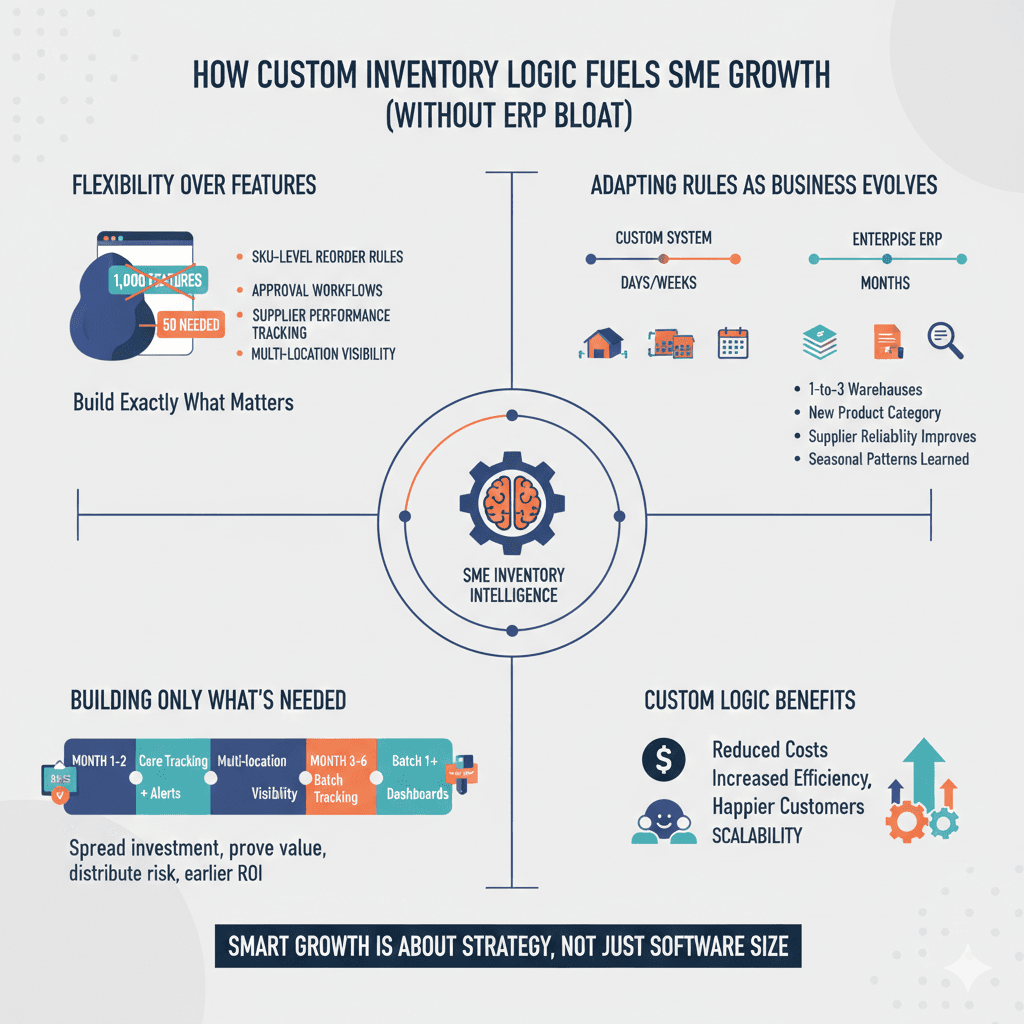
Moving beyond Excel doesn't mean implementing enterprise ERP you don't need.
Flexibility over features
Enterprise ERP offers 1,000 features - you need 50. Custom logic builds exactly what matters:
- SKU-level reorder rules you define
- Approval workflows matching your hierarchy
- Supplier performance tracking metrics you care about
- Multi-location visibility without multi-location complexity you don't have
Adapting rules as business evolves
Business changes requiring inventory logic changes:
- Expanding from 1 to 3 warehouses
- Adding new product category with different demand pattern
- Supplier reliability improving (can reduce safety stock)
- Seasonal business learning historical patterns
Custom systems adapt in days/weeks through configuration. Enterprise ERP requires change requests, consultant fees, testing cycles spanning months.
Building only what's needed
Modular approach:
- Month 1-2: Core inventory tracking + basic reorder alerts
- Month 3-4: Add multi-location visibility
- Month 5-6: Implement batch tracking for compliance items
- Month 7+: Layer supplier performance dashboards
Spread investment across quarters. Each module proves value before expanding. Total cost over year equivalent to big-bang ERP, but risk distributed and ROI realized earlier.
FAQ Section
How do SMEs prevent stockouts without overstocking?
Prevent stockouts without overstocking through demand-based reordering using actual consumption patterns, SKU-level safety stock calculated from demand variability, supplier lead time tracking and dynamic buffers, seasonal pattern recognition adjusting triggers, and automated alerts at optimal reorder points—not arbitrary fixed minimums.
What is the best inventory method for small manufacturers?
Small manufacturers need SKU-level reorder rules considering production schedules, batch-level tracking for quality traceability, Bill of Materials (BOM) integration linking raw materials to finished goods, supplier lead time variability buffers, and multi-location visibility if operating multiple facilities. Method matters less than matching logic to operational reality.
When should inventory reordering be automated?
Automate reordering when managing 50+ SKUs, processing 100+ transactions monthly, operating multiple locations, experiencing frequent stockouts despite tracking inventory, or spending 10+ hours weekly on manual reorder decisions. Businesses that use automated inventory management systems reduce stockouts by 30%.
Can inventory be managed without a full ERP?
Yes—dedicated inventory control systems provide necessary functionality (reorder automation, multi-location tracking, batch traceability, approval workflows) without ERP complexity. Modular approach starts with core inventory module, adds procurement or finance integration as needed. Many SMEs successfully operate inventory-specific systems integrated via APIs to accounting software.
Why does physical stock not match system stock?
Physical-system mismatches stem from delayed GRN entry (received but not logged), unrecorded adjustments (damage, sampling, internal use), transaction errors (wrong quantities entered), theft or shrinkage, timing gaps (counted at different moments), and reconciliation failures accumulating over time. Inventory accuracy in U.S. retail operations is 63%.
How often should safety stock levels be recalculated?
Recalculate safety stock quarterly for stable businesses, monthly for growing/seasonal businesses, after significant demand pattern changes, when supplier performance shifts, and when adding new products or locations. Reducing stockouts and overstocks can lower overall inventory costs by up to 12% through optimized safety stock.
Conclusion From Tracking to Control
Inventory problems are decision problems disguised as data problems. The solution isn't more tracking, better spreadsheets, or fancy forecasting algorithms - it's systems that make decisions based on rules you define, while surfacing exceptions requiring human judgment.
Control comes from structure, not headcount. Growing from 20 to 50 employees shouldn't require adding inventory staff proportionally - it requires encoding knowledge into workflows that scale.
The transition from reactive tracking to proactive control happens when:
- Reorder decisions follow documented logic, not individual memory
- Exceptions trigger alerts, not require constant monitoring
- Supplier variability gets systematically managed, not repeatedly surprises
- SKU-level differences drive
Still Managing Reorders Manually?
Growing SMEs don’t need bigger teams - they need smarter inventory logic. Know how custom automation replaces static min-max rules and reduces stockout risk.
👉 Book a quick walkthrough to know how to Control Inventory & Reorder