
A customer calls. They need an urgent order - tighter timeline than usual, but they're a good account and the sales team doesn't want to lose the business. A delivery date gets committed on the spot.
Two days later, production hears about it through a forwarded WhatsApp message.
Inventory runs a check and finds that a key raw material is short. The purchase team says the vendor needs five days. Meanwhile, dispatch already has three deliveries going out this week and no bandwidth for another.
The delivery date? It's already been committed to the customer.
This is how many growing manufacturing businesses actually operate - not because people aren't working hard, but because the processes connecting those people aren't built to handle the pace or volume of decisions being made every day.
This isn't a failure of effort. It's a failure of coordination.
In this article, we'll break down how manufacturing operations typically flow inside SMEs, where the gaps appear, and what a more connected system actually looks like in practice.
Quick takeaways:
- Most manufacturing delays begin before production even starts
- Sales, inventory, and production teams often operate in complete silos
- Manual coordination creates invisible bottlenecks that only surface when it's too late
- "Stock available" and "stock ready for production" are often two very different things
- Owners typically discover delays after deadlines are already missed
- Systems should support how the business operates - not the other way around
The real manufacturing workflow
Before getting into where things break, it helps to see the full picture of how a manufacturing order should move through a business.
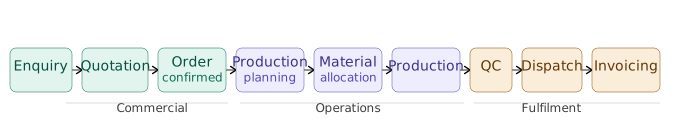
The diagram above shows the complete lifecycle - from the first enquiry to the final invoice. Nine stages. Three distinct phases: commercial, operations, and fulfilment.
Here's what matters: every stage depends on the one before it. A gap at quotation affects production planning. A gap in material allocation stalls the shop floor. A QC delay holds up dispatch. The flow is only as smooth as its weakest handoff.
Most people think manufacturing problems live in the production stage - on the shop floor, in the machines, in the workforce. In reality, many of the most damaging delays begin much earlier - at the desk, in a WhatsApp group, or in a spreadsheet that two departments are updating separately.
Let's break down where things usually start becoming difficult.
Sales and quotation - where operational problems often begin
In a well-structured manufacturing business, sales and operations work closely together. Before a delivery date is confirmed, someone checks actual production capacity. Pricing follows a defined structure. The quotation reflects what the business can genuinely deliver.
That's how it should work.
Here's how it typically works in most growing SMEs:
A customer asks for a price and a delivery timeline. The salesperson - who knows the product and the customer well - estimates both based on experience. They've done it dozens of times. Most of the time, it works out. But the estimate isn't grounded in what's actually happening on the shop floor that week. It's based on what usually happens.
Quotations go out on email. Sometimes WhatsApp. Pricing depends on who's doing the quoting - different people have different mental models of what a job costs. Production isn't consulted. Capacity isn't verified.
And then the order comes in.
A realistic breakdown example:
A regular customer requests 500 units urgently, needed in eight days. Sales says yes - they've delivered similar orders before in that window. The quotation goes out, the customer confirms.
What happens next? The order lands with production via a forwarded message or a verbal update. Production checks the material status and finds that a critical component is at 40% of what's needed. The remaining quantity is on order but hasn't arrived. The purchase team says it'll be there in four or five days. That leaves three days for production and dispatch on an order that normally takes five days of floor time.
The delay was decided at the moment the delivery date was committed - not when production started.
What happens after order confirmation - and why orders get stuck
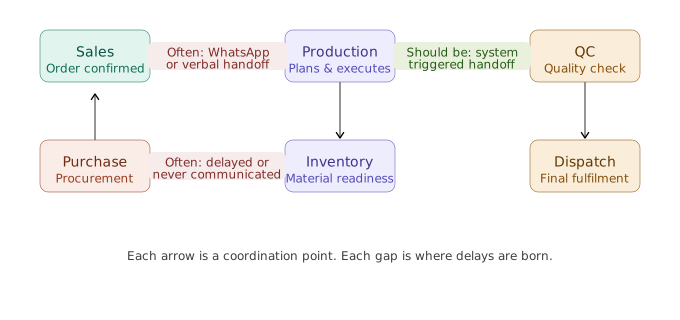
The moment an order is confirmed, the clock starts. But in most manufacturing SMEs, what should be a clean handoff becomes a game of telephone.
Sales marks the order as confirmed in their own file - maybe a spreadsheet, maybe just a WhatsApp message forwarded to a production manager. Specifications are noted somewhere, but not always in the same place production will look. Sometimes the specs are in the original customer email, sometimes in a PDF attachment, sometimes in a verbal conversation that happened on a call.
Production picks it up - but they're already mid-run on two other jobs. The new order goes into a queue that exists mostly in the production manager's head.
Then comes the approval loop. Does the order require an internal approval before production can start? Who approves it? Is it done verbally, or on a form, or via a WhatsApp reply? Once approved, is that approval documented anywhere? Or does it just live in a message thread that's already buried under 60 other messages by the time it matters?
A common scenario that feels familiar to almost every operations team:
Sales thinks the order is in production. Production thinks the material approval is still pending. The customer calls asking for an update. Now begins the chain of calls - sales to production manager, production manager to inventory, inventory to purchase - all trying to figure out where exactly the order stands.
The delay here wasn't caused by the shop floor. It was caused by the gap between departments.
Production planning - the constant rescheduling problem
Production planning in a well-structured operation involves knowing which machines are available, what their capacity is, which jobs are in queue, and how long each job realistically takes. With that visibility, a production manager can sequence orders efficiently and flag conflicts before they become problems.
In most SMEs, planning looks different.
Orders are prioritised verbally. The production manager walks the floor in the morning, looks at what's running, decides what's next. Sequence changes happen throughout the day based on whoever calls or messages most urgently. Machine allocation is based on experience and availability, not a structured plan. Notes live on a whiteboard. The "production schedule" is sometimes a printed sheet updated once a day - or less.
This works when order volume is low and relatively predictable. But as volume grows, the complexity compounds. Not linearly - exponentially.
The rescheduling cascade:
One urgent customer order comes in and gets priority. The production manager pulls Machine 3 from a mid-run job to start the urgent batch. The mid-run job gets pushed. That job was supplying materials for another order that was supposed to go to dispatch tomorrow. Now dispatch is short. The customer on the original job calls wondering about their delivery.
Meanwhile, the supervisor on the floor was working from yesterday's plan - nobody told him about the change. He's still running the original sequence.
Three disruptions from one priority change. None of them visible until someone calls.
As order volume grows, planning complexity grows faster than any manual system can keep up with. The production manager isn't failing - they're managing more variables than any human should be tracking in their head.
Inventory and raw material coordination problems
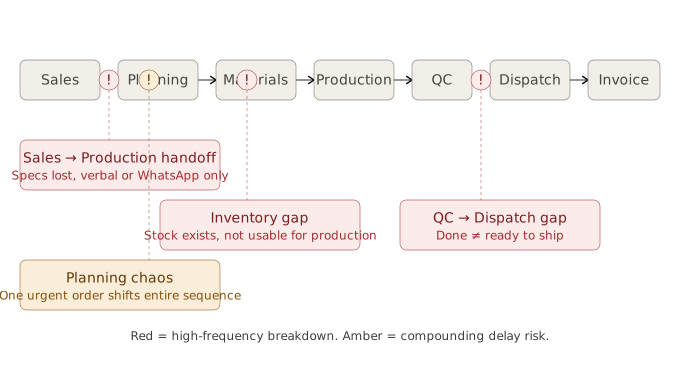
There's a difference between stock that's available and stock that's actually ready for production. Most manufacturing businesses discover this the hard way.
Inventory says 200 units of a raw material are in the warehouse. That's accurate - there are 200 units. But 80 of those are reserved for another job that's already in production. Thirty are in a damaged lot that hasn't been written off yet. Forty are a different specification than what this job needs. The remaining fifty are usable — and the job requires 120.
The inventory system showed 200. Production planned for 200. Reality: 50.
This kind of gap isn't caused by carelessness. It's caused by the way inventory is tracked. When stock is managed in a spreadsheet, or in a system that doesn't connect to production planning, "available" becomes a number — not a status.
What a partial start looks like:
Production begins with the 50 usable units. Machines start. The team works through the first portion of the batch. Then they wait. The remaining material is expected in two or three days. The machine sits idle. The crew moves to a different job. When the material arrives, production needs to be re-set up — adding time that wasn't in the original estimate.
The order doesn't just get delayed. The cost goes up.
Purchase coordination adds another layer. The purchase team is often only brought in after production identifies a shortage. By then, time is already lost. If procurement and production shared real-time material status, the purchase order could be raised before the shortage becomes a production blocker.
What actually happens on the shop floor
Here's a day in the life of a production floor at a growing manufacturing SME.
The shift starts. The supervisor knows what yesterday's plan said. He checks his WhatsApp for any overnight changes. There are three messages - one from the production manager about a priority change, one from sales about a customer request, and one from a team member asking about a machine. The supervisor pieces together what the day should look like and briefs his team verbally.
Work orders exist - but they might be printed sheets from yesterday, or notes on a clipboard, or a cell in a shared spreadsheet that the supervisor updates when he has a moment. Actual production progress isn't tracked in real time. At the end of the shift, someone updates the master sheet - or doesn't, if it's been a hectic day.
Management knows what was planned. They don't know what actually ran.
When a machine breaks down, the supervisor handles it. When a batch has a quality issue, it gets set aside and someone calls the QC team. When a job finishes earlier than expected, the next job may not be ready to start - materials aren't staged, the work order hasn't been issued, the operator isn't sure what to pick up next.
None of these are emergencies. But each one costs time. And those costs add up invisibly.
The owner's experience:
An owner or operations head in this environment is constantly in reactive mode. They find out about delays not from a dashboard - but from a customer complaint, a call from sales, or a floor visit where they see something's off. By the time they know, the delay has often already happened.
The question isn't "can we still make it on time?" It's "how do we explain this to the customer?"
Quality checks, dispatch and last-minute delays
Production completes a batch. The floor team is done. The order should be moving toward the customer.
It isn't.
QC needs to run their check. In a structured operation, QC is built into the production schedule - it's expected, timed, and resourced. In many SMEs, QC happens when QC is available. If the QC team is occupied with another batch, this one waits. The wait isn't tracked anywhere - it just sits in a physical queue.
Once QC approves, the batch moves to finished goods. Now dispatch needs to pick it up. But dispatch has their own workload - existing deliveries, vehicles to coordinate, drivers to brief. An order landing in finished goods doesn't automatically trigger dispatch scheduling. Someone has to notice, communicate, and act.
A common last-minute breakdown:
The batch is approved by QC. It moves to finished goods. Dispatch gets word - but the packaging materials for this specific product are out of stock. Nobody checked packaging before the batch was completed. The order sits finished but unshippable.
Sales calls the customer to reset the delivery date - for the second time.
Here's the reality: production completion is not the same as ready for dispatch. There are layers between the shop floor and the customer - QC, packaging, documentation, logistics - each with their own status, their own team, and their own communication gaps.
Why manufacturing owners struggle with real-time visibility
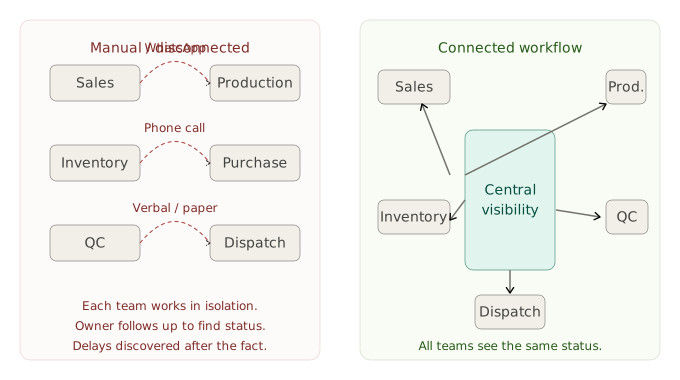
Every breakdown described in the sections above has one thing in common: information existed somewhere - but it wasn't in the right place at the right time for the right person to act on it.
Sales knew the order was confirmed. Production didn't have the full specifications. Inventory had numbers but not statuses. The production manager knew about the priority change but hadn't communicated it. QC finished the batch but hadn't flagged it to dispatch.
No one was hiding information. It just wasn't moving.
This is the root cause of most manufacturing operational problems in SMEs - not lazy teams, not bad people, not wrong decisions. It's that the business has grown faster than the systems connecting it.
The tools multiply. The visibility doesn't.
As businesses grow, teams add tools to manage their piece of the problem. Sales gets a CRM. Production gets a scheduling spreadsheet. Inventory gets a stock management file. Each tool is helpful in isolation. But they don't talk to each other. Data that exists in one place has to be manually communicated - via call, message, or email - to become useful somewhere else.
By the time that data arrives at its destination, it's already slightly out of date.
The owner sits at the top of this structure trying to see the full picture. They can't - not without making five calls and waiting for five people to update their own files. So they manage through follow-ups. Daily check-ins. Morning calls. WhatsApp status requests.
That follow-up loop is itself a sign of the structural problem. The owner is doing the job that a connected system should be doing.
What a better manufacturing workflow looks like
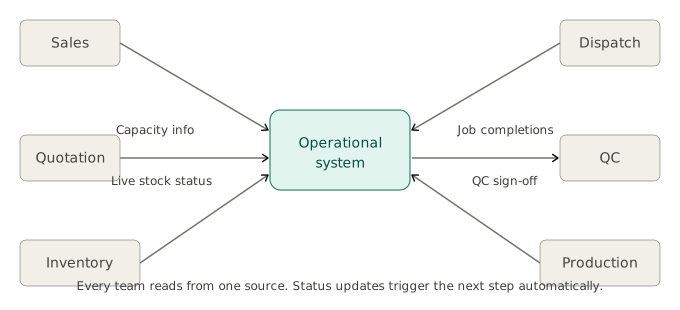
This section isn't about software. It's about how the workflow should function - and what changes when it does.
When a manufacturing business's processes are connected, the experience for each team changes practically.
Sales can see what's in production before committing a delivery date. They're not guessing based on experience - they're working from actual capacity data. When they confirm an order, that confirmation flows directly into production planning without a phone call or a forwarded message.
Production planning knows what's coming before it arrives. Orders enter a queue that reflects real machine availability and real material status. A priority change updates the sequence automatically - instead of the production manager having to manually communicate a cascading change to everyone it affects.
Inventory isn't just showing numbers. It's showing usable, available status - distinguishing between stock that's physically present and stock that's actually free for the next job. When a shortage is identified, procurement is notified in time to act - not after production has already started.
The shop floor works from current work orders, not a sheet printed yesterday. Status updates happen as jobs progress, not at end of day. When a job completes, QC is notified automatically. When QC clears it, dispatch sees it immediately.
The owner or operations head isn't chasing updates. They can see where every order stands - which are on track, which are at risk, which need a decision - without making a single call.
An important thing to say here: every manufacturing business operates differently. The flow of approvals, the structure of pricing, the way production is sequenced - these aren't standard. A job shop looks nothing like a process manufacturer. Custom fabrication looks nothing like high-volume assembly.
That's why systems need to adapt to how a business already works, not the other way around. A tool that forces a business to change its approval structure, its production logic, or its pricing model to fit the software is solving the wrong problem.
The right approach is a system that maps to the actual workflow - built around how the business operates, not how some standard template assumes it should.
Final thoughts
Manufacturing complexity doesn't live on the shop floor alone. It lives in the space between departments - in the handoffs, the communication gaps, the approval loops, the information that exists in one place but is needed in another.
Most manufacturing businesses don't slow down because people aren't working. They slow down because information moves inconsistently. A committed delivery date that wasn't checked against capacity. A material shortage that wasn't visible until production was already supposed to start. A completed batch that wasn't flagged to dispatch because nobody sent the message.
These aren't unusual situations. For most growing SMEs, they're Tuesday.
The path forward isn't about adopting the biggest or most complex system available. It's about building the right structure for the way the business actually operates - one where coordination doesn't depend on follow-up calls, where status is visible without asking, and where every team is working from the same information.
If your teams are constantly coordinating through calls, spreadsheets, and follow-ups just to keep daily operations moving - it may be worth looking at how your workflows connect to each other. At Creviz, we build operational systems designed around how your business already works.