
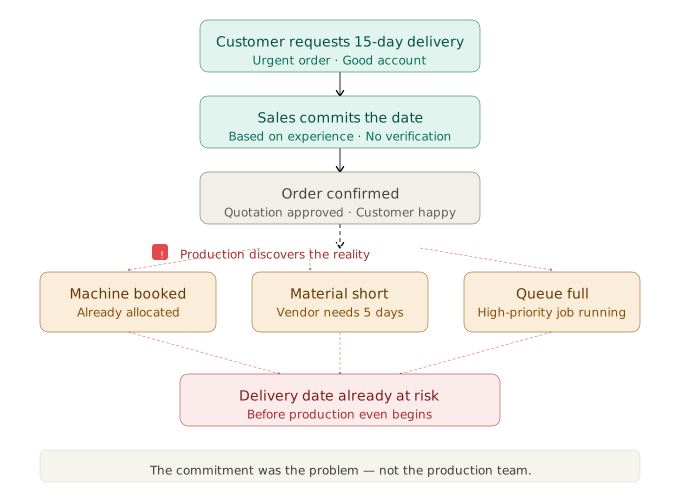
A customer calls. They need an order - tighter timeline than usual, but they're a good account. The sales team doesn't want to lose the business.
A delivery date gets committed. The quotation goes out. The customer confirms.
Only then does production discover the full picture:
The machine needed for this job is already running another order. A critical raw material isn't available in the required quantity. A high-priority order from last week is still mid-run and hasn't cleared yet.
What looked like a successful sale has become an operational problem - before a single unit has been produced.
This is not an unusual situation. In most growing manufacturing businesses, this is a pattern. And the pattern almost always starts in the same place - at the quotation stage, before production ever gets involved.
Quick takeaways
- Many manufacturing delays begin before production starts
- Delivery commitments are often made without real operational visibility
- Small decisions at the quotation stage impact multiple departments downstream
- Production planning becomes reactive when commitments are unrealistic
- Better coordination doesn't mean slower sales - it means more accurate decisions
The quotation stage is more important than most businesses realise
Ask most manufacturing business owners what a quotation is, and the answer is consistent: it's a pricing document. It has the quantity, the rate, the payment terms, and a delivery date.
That framing is not wrong. But it's incomplete.
Because the moment a delivery date appears on a quotation - even as an estimate - something else happens alongside the commercial agreement.
Production capacity is indirectly committed. Material availability is assumed. Resource allocation is implied. The customer reads that date as a promise, not a placeholder.
A quotation is not just a commercial document. In most manufacturing businesses, it is the first operational commitment - made before operations has been consulted, before material has been checked, and before the production schedule has been reviewed.
This is the gap where most delivery problems are born.
As we covered it in our detailed blog about how manufacturing businesses actually operate, the manufacturing lifecycle runs from enquiry all the way through to invoicing - and each stage creates dependencies for the next. The quotation stage sits right at the beginning of that chain. Decisions made there echo through every department that follows.
Why sales teams often make commitments they can't validate
Before getting into the operational impact, it's important to say this clearly: sales teams are not the problem.
They are operating in a system that gives them limited tools to make operationally informed decisions quickly.
Here's what that looks like in practice.
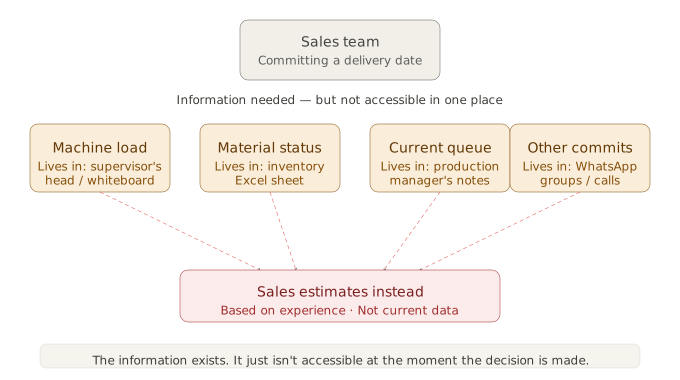
A customer asks for a delivery timeline. The salesperson needs to respond - ideally today, because the customer has other options. To find out the accurate answer, they would need to know: current machine availability, existing production load, raw material status, and whether any other high-priority orders are already in the queue.
That information exists. But it's spread across an Excel sheet the production manager updates, a WhatsApp group where someone mentioned a material delay two days ago, and a conversation that happened verbally on the floor yesterday morning.
There is no single place to look. There is no fast answer.
So the salesperson does what makes sense given their constraints - they estimate based on experience. They've delivered similar orders in similar timelines before. Most of the time, it works out.
When it doesn't, the downstream impact is significant.
The pressure to close orders is real. The fear of losing a customer to a competitor who says yes faster is real. The problem isn't the intent - it's that the system offers no practical way to verify commitments at the speed sales decisions need to be made.
How one delivery promise creates a chain reaction across operations
This is where the real operational cost becomes visible.
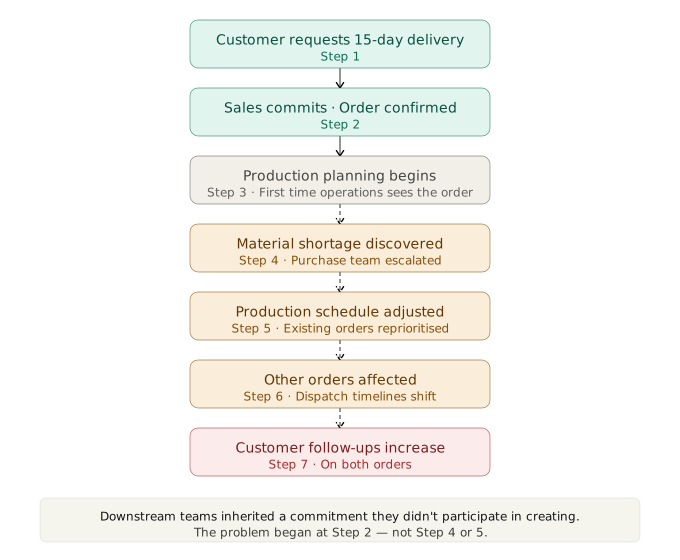
Walk through what actually happens after a commitment is made without operational verification:
Customer requests 15-day delivery.
Sales commits based on experience and past performance. The quotation is approved and sent. The customer confirms.
Order confirmation reaches production.
Not immediately - usually via a forwarded message, an email, or a verbal update. Production planning begins. This is often the first moment production sees the actual timeline.
Material check happens.
Inventory is reviewed. A critical raw material is short - not enough to complete the full order. The purchase team is informed. The vendor needs four to five days for delivery.
Production schedule is reviewed.
The machine required for this job is already allocated to another order. That order has its own committed delivery date. A decision needs to be made: which order takes priority?
Rescheduling begins.
One order gets pushed. The team working on the deprioritised job is reassigned or sits idle while the setup changes. The supervisor on the floor is now working from a different plan than the one briefed at the start of the shift.
Existing orders are affected.
The order that got pushed had its own customer waiting. That customer now needs to be contacted. Sales gets involved again - this time to manage expectations on a different account.
Customer follow-ups increase.
The original customer - the one who placed the urgent order - starts calling for updates. The answer requires piecing together information from production, inventory, and purchase before anyone can respond accurately.
The issue here is rarely a single bad decision. The issue is that downstream teams inherit commitments they had no part in creating. By the time production, inventory, and dispatch are involved, the deadline is already fixed, the customer expectation is already set, and the only option is to absorb the disruption and manage the fallout.
This chain reaction is exactly why production planning in manufacturing SMEs so often becomes a reactive exercise rather than a structured one - teams are constantly adjusting to commitments that arrived without context.
The hidden costs of unrealistic commitments
The immediate cost of a missed delivery is visible - a delayed order, an unhappy customer, an awkward call. But the full cost runs deeper than that.
On the production floor:
Rescheduling doesn't just move dates. It disrupts machine sequences, changes crew assignments, and creates setup time that wasn't accounted for in the original estimate. Overtime gets added. Urgent work orders jump the queue. The floor operates in fire-fighting mode instead of executing a structured plan.
On inventory and procurement:
Emergency purchases happen at premium prices. Vendors who can deliver quickly charge more. Inventory management takes a hit - stock that was planned for one job gets redirected, creating shortages elsewhere in the pipeline.
On the team:
Constant rescheduling, constant follow-up, and constant escalation creates a working environment where the day is spent reacting rather than executing. Production managers spend more time recovering from planning decisions than running production. That toll is real, even if it doesn't show up on a balance sheet.
On customer relationships:
A delayed delivery once is a problem. A pattern of delays changes how a customer sees the business - not as an unreliable team, but as an unreliable operation. Trust erodes. Repeat business becomes uncertain.
On the owner:
Without visibility into where things stand, the owner ends up in the middle of every escalation. Morning calls, WhatsApp check-ins, floor visits to piece together a status update that should have been visible at a glance.
The cost of an unrealistic commitment is often much higher than the margin value of the order that triggered it.
Why production teams get blamed for problems that started earlier
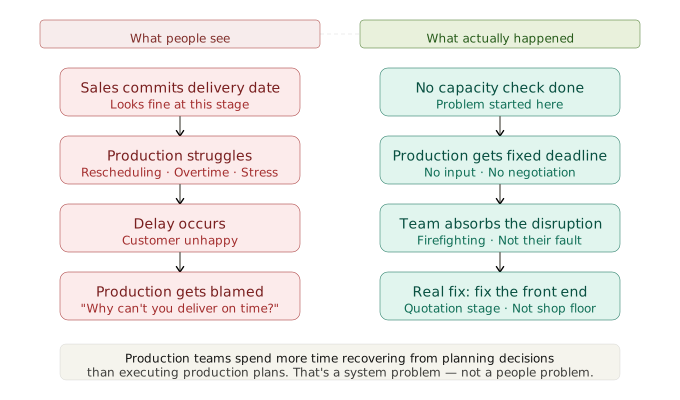
There is a pattern that plays out in manufacturing businesses with disconnected workflows:
Sales commits → Production struggles → Delay occurs → Production gets blamed.
It's a frustrating cycle, and it's unfair - because by the time production is involved, the constraints have already been set.
The deadline is fixed. The customer expectation is established. The material shortage is someone else's problem to solve. Production receives the commitment as a given and is expected to deliver against it regardless of whether it was operationally feasible when it was made.
Many production teams spend more time recovering from planning decisions than executing production plans. That's not a reflection of capability. It's a reflection of what happens when the front end of the business - sales, quotation, order acceptance - operates without real-time operational input.
The production team didn't set the delivery date. They're just the ones visible when it's missed.
This is why solving the problem at the quotation stage matters so much. It's not about controlling sales. It's about giving every part of the business the information it needs to make decisions that the whole operation can actually support.
What better coordination looks like before an order is confirmed
Better coordination at the quotation stage doesn't mean every quote requires a meeting. It doesn't mean sales has to wait for a production sign-off before responding to a customer.
It means that when the commitment is being made, the right information is already accessible.
Before a delivery date is confirmed, sales should ideally be able to see - without making three calls:
- Current production load and machine availability
- Raw material status for the relevant components
- Existing committed orders and their timelines
- Any known constraints in the upcoming schedule
This changes the nature of the conversation. Instead of estimating and hoping, the salesperson is working from actual operational data. The answer might still be yes - but it's an informed yes, with a date that production can realistically meet.
For order tracking and management, this kind of front-end visibility also means that when an order is confirmed, the handoff to production carries all the context it needs - specifications, timeline, material requirements - without a follow-up message or a manual transfer of information.
The goal isn't a slower sales process. Fast decisions are valuable. Accurate decisions are more valuable. A sales team that can say yes confidently - based on what's actually possible - closes business and protects the operation at the same time.
Conclusion
Production delays often don't begin on the shop floor.
They begin during quotations, during delivery commitments, during order acceptance - in the moments before production is involved at all.
When sales, production, inventory, and planning operate with limited visibility into each other's constraints, even well-intentioned commitments create disruption downstream. Production gets handed a timeline it wasn't consulted on. Inventory gets raided for a job it didn't know was coming. Dispatch gets an order it can't fit.
The fix doesn't start on the shop floor. It starts at the quotation stage - with information that moves between teams before commitments are made, not after.
If your team frequently relies on calls, spreadsheets, and follow-ups just to validate a delivery date before confirming an order, it may be worth examining how information moves between sales and operations at the point when it matters most - before the customer says yes.
At Creviz, we build operational systems that give sales and production a shared view of what's actually possible - designed around how your business already works.